
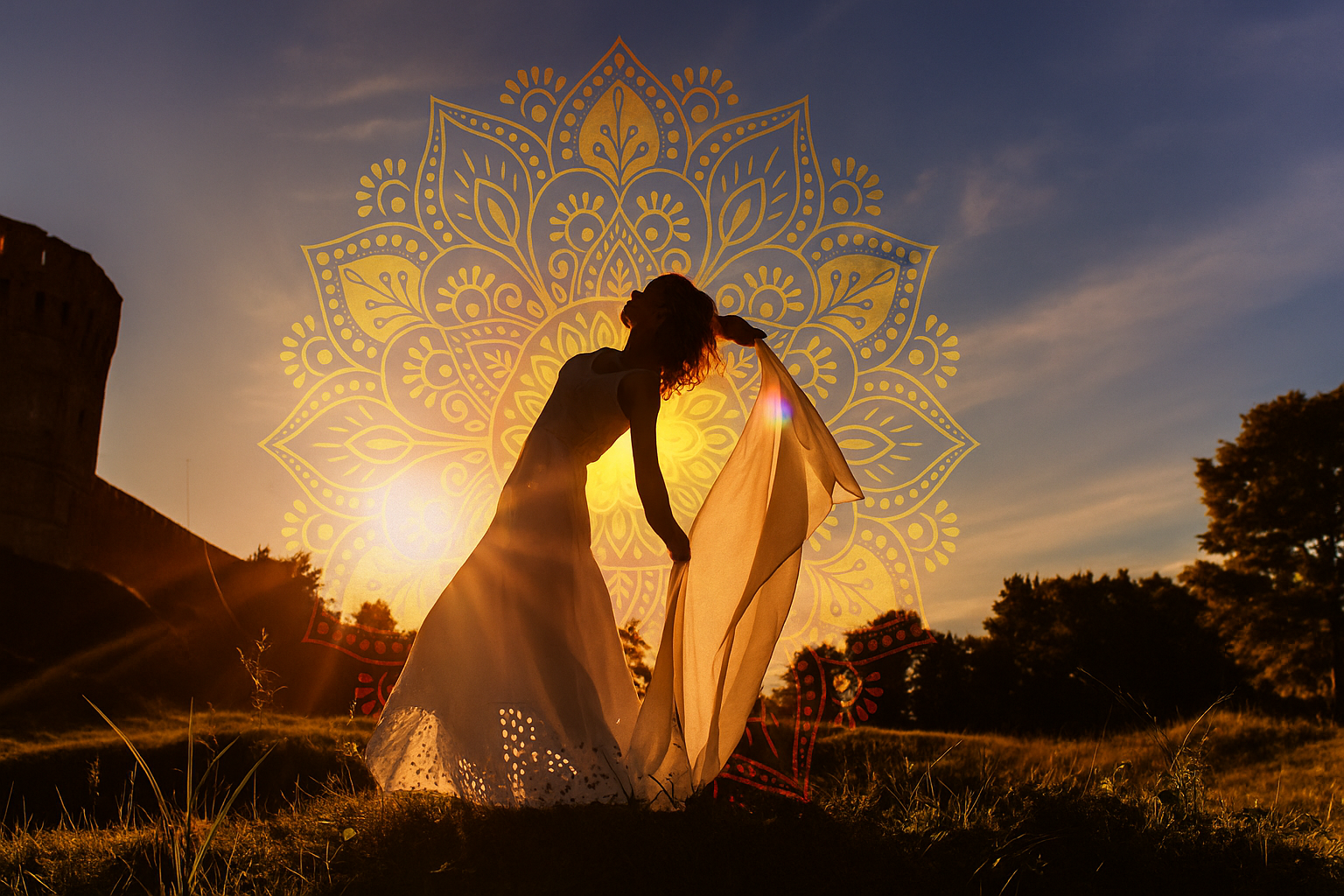
The Body as Mandala — Movement Toward Wholeness
The mandala is an archetypal image whose occurrence is attested throughout the ages.
C.G. Jung, Memories, Dreams, Reflections
It signifies the wholeness of the Self. I had to draw them; only gradually did I discover what the mandala really is: … the Self, the wholeness of the personality which, if all goes well, is harmonious.
An Archetype of Wholeness
As the year draws to a close, we are invited to turn inward—to the quiet, radiant center at the heart of the mandala, where all opposites are reconciled. Across cultures and centuries, the mandala has appeared as a sacred image of order, an ancient geometry through which the human psyche restores coherence and meaning.
In Sanskrit, mandala means “circle” or “sacred center.” It is both a symbol and a process—a living movement of consciousness that mirrors the evolution of the soul. In the yogic tradition, the chakras form an inner mandala, each lotus unfolding toward greater integration and awakening. Jung, encountering similar circular images in his dreams and art, came to see the mandala as an archetype of the Self—the organizing principle that draws the fragments of the psyche into wholeness.

In both depth psychology and Kundalini Yoga, the mandala represents the same truth: wholeness arises not through avoidance or perfection, but through integration—the conscious uniting of opposites within a larger, luminous field.
Mandala Depicting Kalachakra and Vishvamata, Tibet, first half 16th Century, 54.6 x 49.5 cm.
The Mandala and the Inner Journey
Jung observed that when individuals drew or dreamt mandalas, these images often emerged spontaneously during times of transformation. The psyche, seeking balance, generates a pattern of order around a unifying center. In his words, “the mandala serves the conservative purpose of restoring order—but also the creative purpose of giving expression to something new.”
In yogic language, this newness arises through the movement of kundalinī śakti, the spiraling current of consciousness that ascends toward awakening. The mandala is not simply seen but felt—as circular currents of energy and awareness within the body. Each breath becomes a turning of the wheel, each kriya a re-centering of the whole.
To work with the mandala, then, is to engage the art of conscious return: to trace our way back to the center from which life continually unfolds.
Holding the Tension of Opposites
For Jung, individuation—the lifelong process of becoming whole—requires holding the tension of the opposites. Rather than identifying with one pole of experience, we are called to sustain the dynamic relationship between them: light and shadow, conscious and unconscious, ego and Self. When this tension is held consciously, something new emerges—a third, reconciling symbol that integrates what was once divided.
In Kundalini Yoga, this same principle is experienced through the body and breath. Every kriya, pranayam, and meditation becomes a practice of staying present at the meeting of opposites: effort and surrender, stillness and motion, inhalation and exhalation. The ego’s impulse is to control or withdraw; the practice invites courageous surrender—a willingness to stay with the living edge until harmony arises naturally.

In that sustained awareness, the body itself becomes a mandala: a dynamic field of energy where opposites integrate, spiral, and refine toward coherence.
Leonardo Da Vinci – Photo from www.lucnix.be
The Numinous Center
At the heart of every mandala lies a luminous center—the still point that unites the many. In Jung’s psychology, this center corresponds to the Self: the numinous source of order, purpose, and vitality within the psyche. In yogic philosophy, it is the bindu—the radiant seed from which all creation emanates and to which it returns.
When awareness settles into that inner point, we experience a profound quieting of duality. The sense of separation begins to dissolve, revealing a subtle yet unmistakable feeling of peace, clarity, and interconnectedness. From this inner stillness, true prosperity arises—not as material acquisition, but as the abundance of energy, insight, and love that flows when we are aligned with the deeper rhythm of life.
Series Overview
🕉️ December 2025 Kundalini Yoga Series
Theme: The Body as Mandala — Movement Toward Wholeness
When: Sundays at 9 AM Pacific / 12 Noon Eastern
Where: Live on Zoom (link provided prior to the first class)
Length: 75 minutes — pranayam, kriya, meditation, and reflection
Tuition: Donation-based (no one turned away). Recommended donation: $49 for the series

Curriculum
Each class blends Jung’s insights on mandala psychology with the embodied geometry of Kundalini Yoga—uniting breath, movement, meditation, and reflection as pathways toward wholeness.
Week 1 – Drawing the Circle: Center & Periphery
We begin by grounding in the body as sacred geometry. Through breath and foundational postures, we establish the boundary of our inner circle and awaken the felt sense of center. The mandala becomes a vessel of containment and coherence—a sacred space for the psyche to unfold.
Week 2 – The Four Gates: Integrating the Directions
The mandala’s cross within the circle symbolizes the unification of opposites. This week explores balance between prana and apana, left and right, inner and outer. Through kriya and mantra, we align the four directions of our being—physical, emotional, mental, and spiritual—into dynamic harmony.
Week 3 – The Inner Petals: Motion Toward the Center
Moving from the periphery toward the heart, we explore the mandala as a living process of integration. Practices open the heart, throat, and intuitive centers, deepening our awareness of the inner light that unites multiplicity into unity. Participants are encouraged to begin or continue creating their own mandalas—a meditative art process that reflects inner transformation.
Week 4 – The Center of Wholeness: Blessing the New Cycle
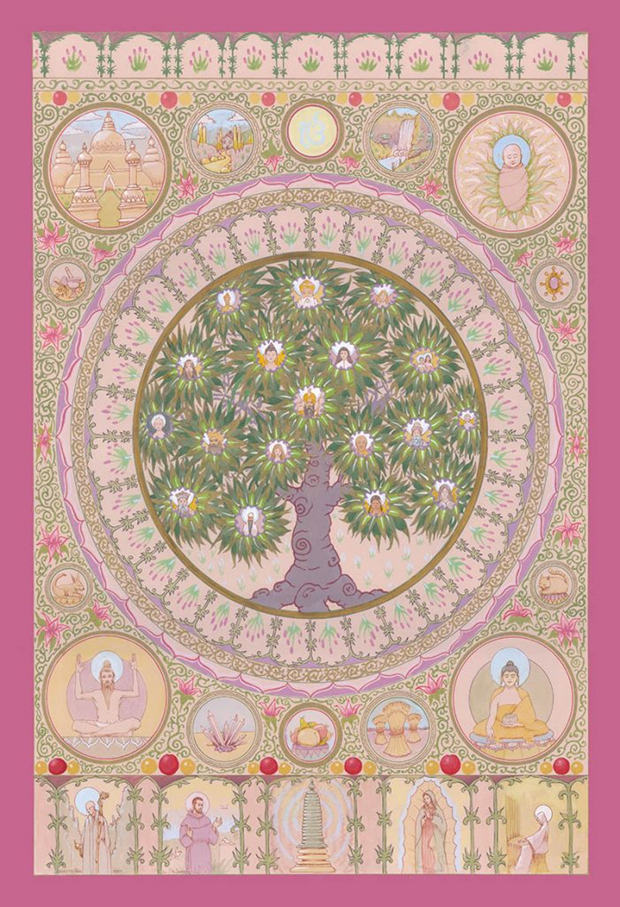
In our final gathering of the year, we enter the still point—the numinous center where opposites dissolve into one. The luminous heart of the mandala represents the inexhaustible source from which new life continually emerges. Guided by Sewa Singh Khalsa’s Prosperity Mandala, we attune to the radiant flow of energy that renews and sustains us. As we rest in that sacred space, prosperity is re-understood—not merely as material blessing, but as the inner abundance of vitality, clarity, and grace that arises when we are aligned with the Self.
During our community integration, participants are invited to share their own mandalas, offering a glimpse into the many expressions of the One Self and the universal geometry that unites us all.
https://studentsofyogibhajan.com/prosperity-mandala-poster/Artist Credit: Sewa Singh
Takeaway
Participants will come to understand that:
- Wholeness is not static perfection but a living pattern continually re-centering.
- The body itself is a mandala—a sacred vessel where opposites integrate through awareness.
- Breath, movement, and mantra enact the same archetypal process Jung saw in dreams and art: chaos resolving into order, multiplicity folding into unity.
Join the Circle
Come gather in this season of completion and renewal. Together, we’ll enter the sacred geometry of the body, breathe into the center, and rediscover the quiet radiance that holds all things in balance.
Disclaimer:
These classes are intended for educational and experiential purposes only and are not a substitute for medical or psychological care. Please consult your physician before beginning any new physical or breath-based practice. Always honor your body’s limits and rest as needed.
This series draws from a wealth of ancient yogic, psychological, and spiritual themes rooted in diverse traditions. While Kundalini Yoga has been popularized in the West through various lineages, including that of Yogi Bhajan, I do not endorse or condone the actions he has been accused of. My teaching is informed by years of study, personal practice, and a deep respect for the timeless wisdom that transcends any one individual.